
Affiliate Disclosure: Our reviews are 100% independent. If you buy through our links, we may earn a small commission that helps us maintain the site at no extra cost to you. For more information, please review our Privacy Policy and Terms of Service.
Upgrading to a Direct Drive (DD) wheelbase is the ultimate turning point in a simracer’s life. However, your entire investment in a premium wheelbase can be ruined if you mount it on the wrong chassis. If you have configured an ecosystem with a base generating between 8 and 15 Nm (such as the Moza R9, Moza R12, Fanatec ClubSport DD, Logitech G PRO, or Simagic Alpha Mini), your hardware generates torsional forces that would destroy a desk or a basic folding stand in weeks. Furthermore, braking with load cell pedals in this category requires withstanding extremely high pressures. For this power range (the current sweet spot of Sim Racing), you need to look into mid-range sim racing cockpits. Below, we deeply analyze the 5 best market options in 2026 that will offer professional rigidity to squeeze every detail out of your Force Feedback.
Playseat Trophy: Innovation, Lightweight, and Frameless Seat Design
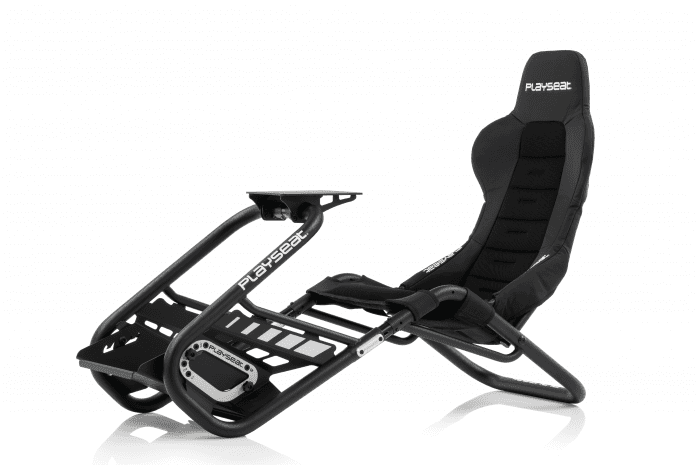
The Playseat Trophy is not a traditional cockpit. Instead of bolting a car seat onto a metal base, Playseat designed a continuous tubular structure over which a high-tech ActiFit material cover is tensioned.
Construction and Rigidity: It is manufactured from high-carbon steel. Its frameless design means the pilot’s full weight tightens the structure, providing surprising structural rigidity in the wheel area. It weighs only 16 kg, making it the only chassis on this list you can easily move around the room.
Comfort and Adjustments: The ActiFit material is extremely breathable. It allows adjusting the backrest inclination, wheel height/tilt, and pedal distance. However, pedal adjustment uses telescopic bars requiring tools, which is slow if you share the rig.
Maximum Force (Nm): Playseat certifies full compatibility with Direct Drive wheels. Co-developed with Logitech for their 11 Nm G PRO base, it handles up to 15 Nm with no noticeable flex.
- Pros: Featherweight (16 kg) and spectacular aesthetics; Superior breathability thanks to the ActiFit fabric; Excellent wheel deck rigidity for its weight.
- Cons: Adjusting distance for different drivers requires tools; Shifter/handbrake mount is usually sold separately.
Next Level Racing F-GT: The Swiss Army Knife (Formula and GT)
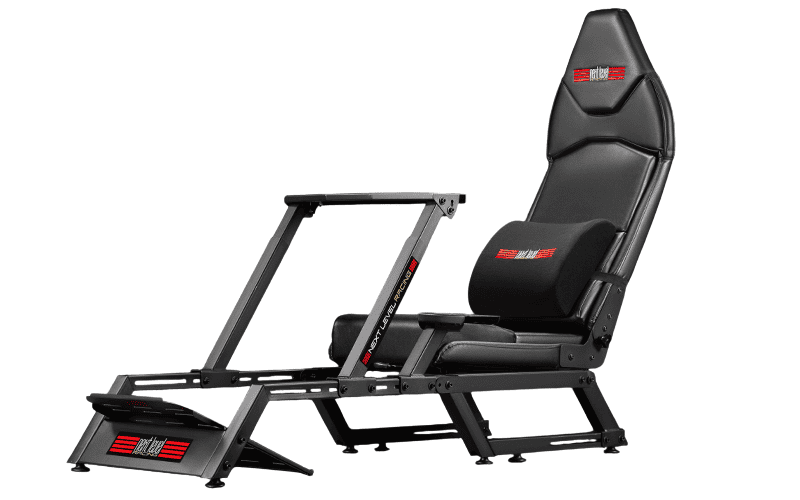
The NLR F-GT is a global bestseller for a simple reason: it lets you drive a Formula 1 car almost lying down and a GT car sitting upright, all in the same chassis, making it one of the most versatile mid-range sim racing cockpits available.
Construction and Rigidity: Made of carbon steel. This is a heavy structure weighing nearly 40 kg, which helps absorb Direct Drive motor vibrations. The pedal plate is solid and pre-drilled to prevent flex under hard load cell braking.
Comfort and Adjustments: It comes standard with a lumbar cushion, seat sliders, and a shifter mount. Switching from GT to Formula position requires unbolting several parts. The seat, being flat to accommodate both postures, can feel firm after a couple of hours.
Maximum Force (Nm): The brand indicates it is “designed for Direct Drive wheels.” It is a community standard for bases between 10 and 15 Nm.
- Pros: Unique in its category with true Formula and GT positions; Includes seat sliders and shifter mount out of the box; Large structural mass that dissipates vibrations well.
- Cons: Switching between GT and Formula postures takes about 15-20 minutes of work; Stock seat lacks advanced ergonomics.
Sim-Lab GT1 Evo: The Undisputed King of Aluminum
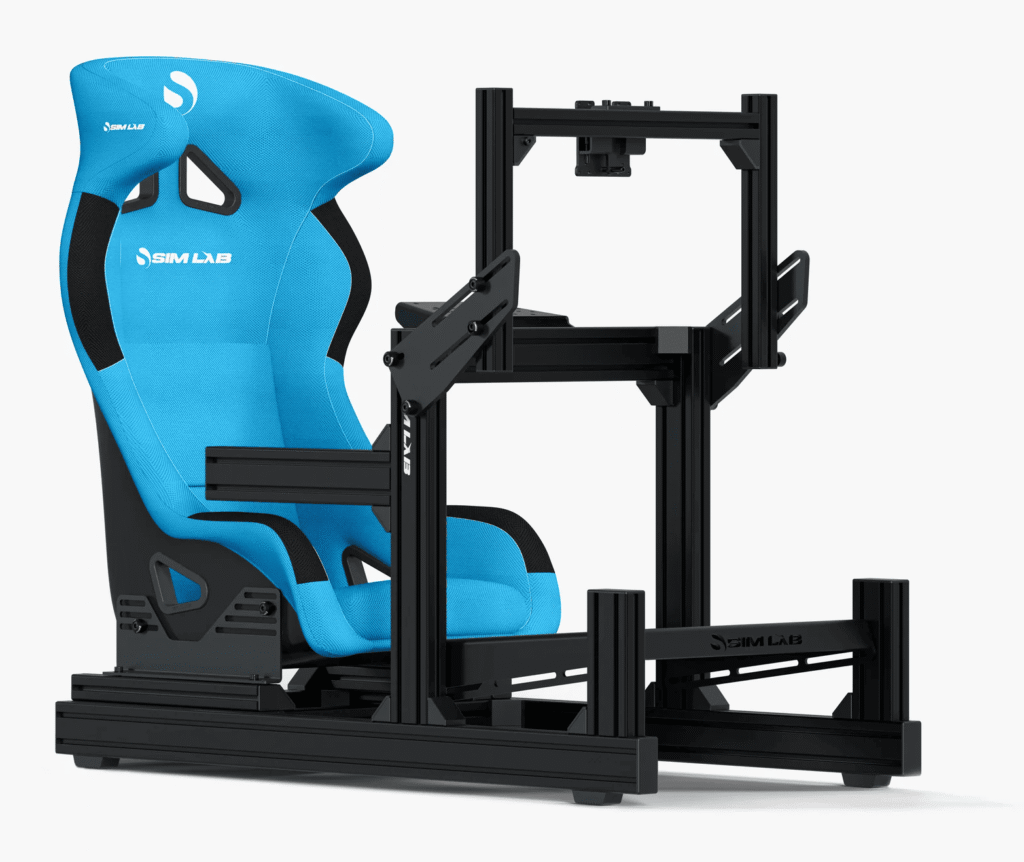
Here we change the game rules. The GT1 Evo is not tubular; it is an aluminum profile cockpit (80/20). It is globally considered the best entry gate to professional chassis due to its unbeatable value.
Construction and Rigidity: It uses 40×80 mm aluminum profiles, meaning rigidity is almost absolute. The wheel deck was recently redesigned, and the pedal tray is hardened steel, enduring extreme load cell pedals without yielding a single millimeter.
Comfort and Adjustments: Being aluminum, modularity is infinite. You can adjust the seat, wheel, and pedals to the exact millimeter, and add any future accessory using standard nuts and bolts. Keep in mind the chassis base price excludes the seat.
Maximum Force (Nm): Sim-Lab states it offers “more than enough rigidity for most wheels” and is fully compatible with Fanatec, Moza, and Simagic ecosystems. It handles 15 Nm effortlessly and can withstand future upgrades to 20 Nm.
- Pros: Unbeatable aluminum rigidity at a very accessible price point; Infinite modularity: adjust any part to the millimeter; Future-proof investment.
- Cons: Seat and seat brackets must be purchased separately; Initial assembly is complex and requires patience.
Playseat Sensation Pro ActiFit: The Luxury of eSports
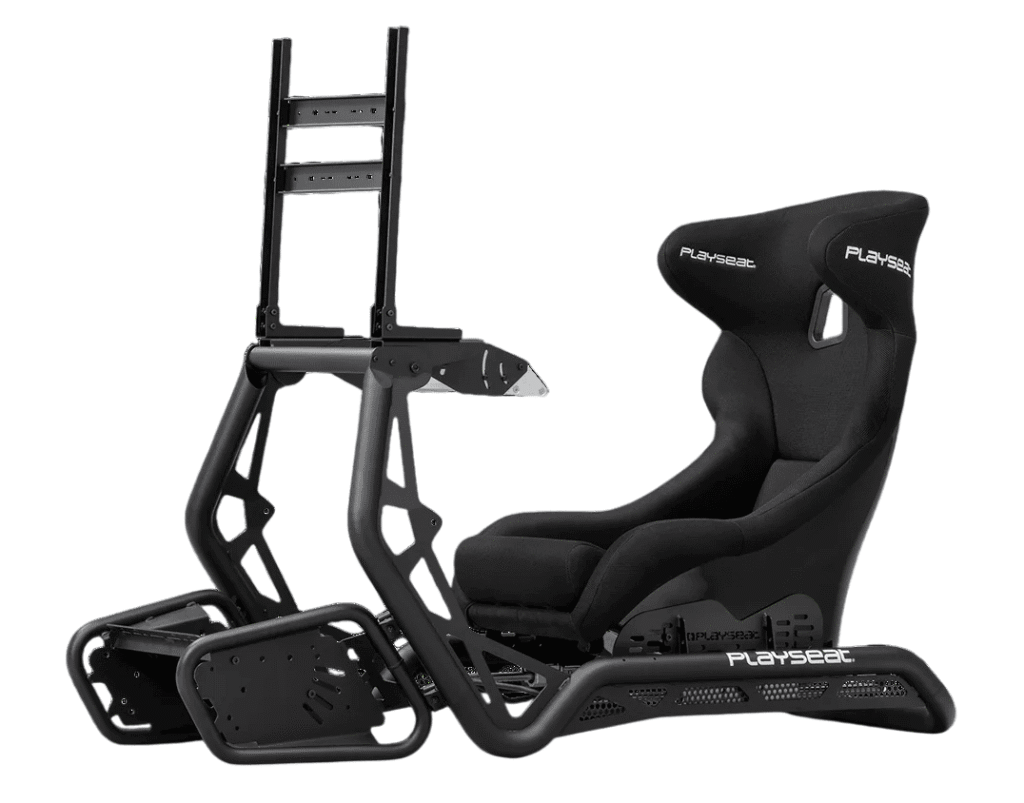
If the investment is not an issue and you want the tubular structure used by professional drivers in FIA or WRC events, the Sensation Pro is your candidate. It is a premium chassis designed to stay rock solid.
Construction and Rigidity: A massive industrial steel structure with a spectacular curved frame design. The wheel plate is supported by a massive frontal structure that eliminates any vertical or horizontal flex, regardless of how aggressive the Direct Drive is.
Comfort and Adjustments: Equipped with a real bucket seat lined in breathable ActiFit fabric. The adjustment system is patented by Playseat to withstand hard treatment in events, allowing fast and ultra-secure distance adaptations.
Maximum Force (Nm): As a commercial-grade chassis for eSports competitions, it is fully tested with Direct Drive bases of 15, 20, and up to 25 Nm.
- Pros: Commercial eSports grade stability and rigidity; Spectacular and highly immersive design; Hyper-robust seat with high-quality breathable material.
- Cons: Belongs to a premium price tier that is prohibitive for many users; Takes up massive physical space in the room.
Next Level Racing GTTrack: The Gateway to Professional Motion
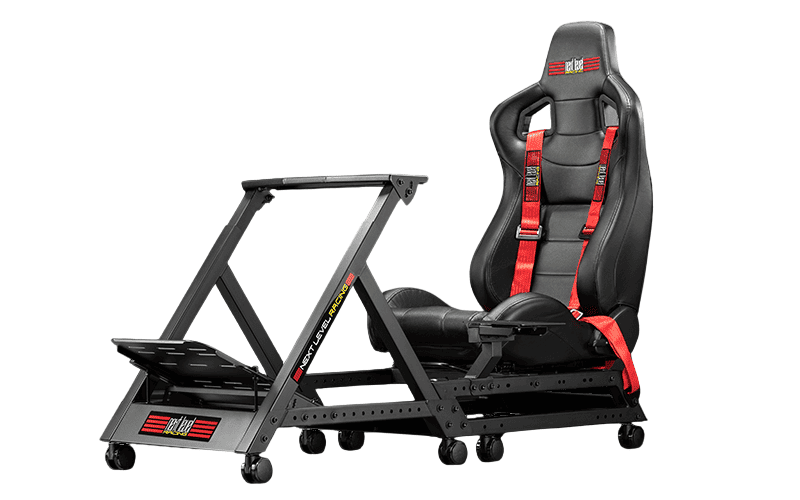
The GTTrack is built under a very clear premise: if you use powerful hardware and might add motion platforms in the future, you need a base that resists everything among the available mid-range sim racing cockpits.
Construction and Rigidity: The GTTrack structure is massive and heavy. It is designed from scratch to be compatible with the brand’s motion platforms, meaning the chassis must withstand not only the 15 Nm wheel force but the violent motion of your whole body.
Comfort and Adjustments: Unlike others, the GTTrack comes factory-loaded with luxury extras: lockable caster wheels (essential given its weight), seat sliders, shifter mount, and even a 4-point racing harness. The seat is firm, focused on maintaining posture under harsh braking.
Maximum Force (Nm): Next Level Racing explicitly promotes it for “professional Direct Drive wheels”. Handling 15 Nm is a breeze for this chassis, and it is structurally prepared for the combined forces of a full ecosystem.
- Pros: Hyper-robust construction ready for motion platforms; Includes lockable wheels and 4-point harness as standard; Zero flex in pedals and wheel.
- Cons: Somewhat industrial design compared to others on the list; Represents a higher investment.
Final Verdict: Which One Should You Choose?
If you are exploring mid-range sim racing cockpits and want the best value, the Sim-Lab GT1 Evo (aluminum profile) will last you a lifetime. If you have space constraints, want to move it easily, and prioritize comfort, the Playseat Trophy is the winning choice. If you race both iRacing (GT) and F1 26 and want realistic driving positions for both, go for the Next Level Racing F-GT. If you want a simulator that supports motion platforms and comes with standard accessories, choose the NLR GTTrack. If you have a high budget and want the ultimate eSports tubular experience, the Playseat Sensation Pro will not disappoint.